
Homeowner tools
Notice more.
Assume less.
Choose what you are noticing. Each short guide helps you observe the condition without jumping to a diagnosis.
Explore connected systems
One symptom may involve more than one part of a home.
Select a building system to see how observations in one area may connect with conditions elsewhere.
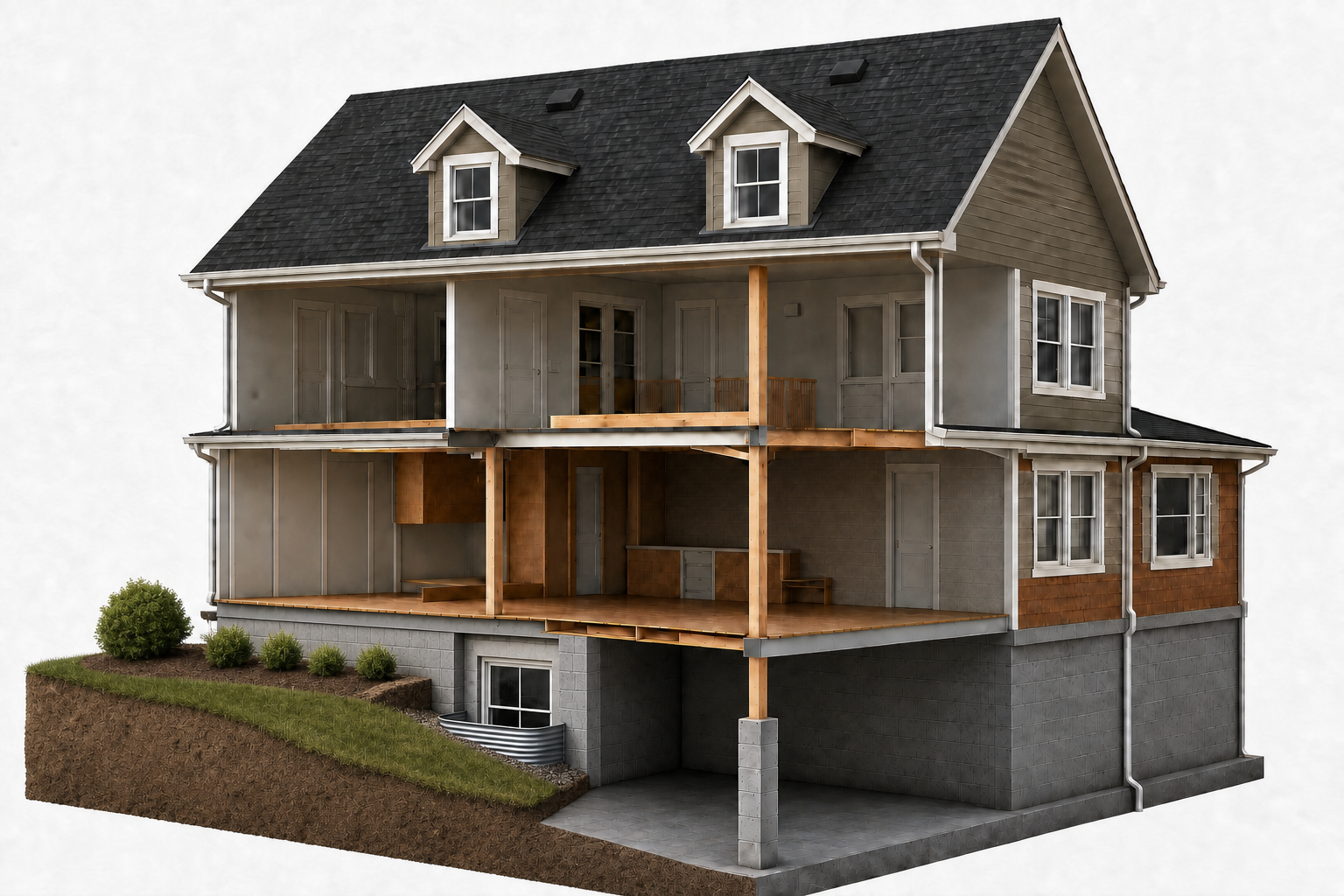
Select a building systemExplore how clues in one part of a home may connect to conditions elsewhere.
Choose what you’re noticing
Open only the guide that is useful to you.
1.Drainage & downspouts
Move roof water away from the foundation and notice where discharge travels after rain.
+
Drainage & downspouts
Move roof water away from the foundation and notice where discharge travels after rain.
What to noticeDisconnected extensions, erosion, ponding, overflowing eavestroughs, or water returning toward the house.
Keep in mindA dry-weather walk cannot show how the system performs during heavy rain.
General education · not a diagnosis of your home2.Grading
Look for low areas, settlement, hard surfaces, or landscape features that direct water toward the home.
+
Grading
Look for low areas, settlement, hard surfaces, or landscape features that direct water toward the home.
What to noticeReverse slopes, settled soil, paths beside foundations, or new landscaping that changes runoff.
Keep in mindSurface grading is only one possible water pathway.
General education · not a diagnosis of your home3.Window wells
Keep wells clear and watch for repeated wetting around basement openings.
+
Window wells
Keep wells clear and watch for repeated wetting around basement openings.
What to noticeDebris, high soil, staining, standing water, damaged covers, or gaps at the window and foundation.
Keep in mindA clear well does not confirm that concealed drainage is present or working.
General education · not a diagnosis of your home4.Attic ventilation
Ventilation works with air leakage, insulation, moisture, roof geometry, and outdoor conditions.
+
Attic ventilation
Ventilation works with air leakage, insulation, moisture, roof geometry, and outdoor conditions.
What to noticeFrost, staining, compressed insulation, blocked soffits, bath exhaust discharge, or seasonal patterns.
Keep in mindAdding vents alone may not address the reason moisture reaches the attic.
General education · not a diagnosis of your home5.Condensation
Surface moisture reflects a relationship among temperature, humidity, airflow, and material location.
+
Condensation
Surface moisture reflects a relationship among temperature, humidity, airflow, and material location.
What to noticeWhen it occurs, which surfaces are affected, indoor humidity, outdoor temperature, and occupancy changes.
Keep in mindCondensation and water entry can sometimes produce similar-looking symptoms.
General education · not a diagnosis of your home6.Sump systems
Know where water enters, where it discharges, how the pump is powered, and what happens during an outage.
+
Sump systems
Know where water enters, where it discharges, how the pump is powered, and what happens during an outage.
What to noticeShort cycling, unusual noise, high water, blocked discharge, freezing, or discharge returning toward the house.
Keep in mindDo not enter a confined space or handle energized equipment in wet conditions.
General education · not a diagnosis of your home7.Ice damming
Snow cover, heat loss, roof geometry, weather, and drainage can combine to create recurring winter symptoms.
+
Ice damming
Snow cover, heat loss, roof geometry, weather, and drainage can combine to create recurring winter symptoms.
What to noticeIcicles, uneven melting, ice at eaves, attic frost, interior staining, and which roof areas are involved.
Keep in mindRoof access in winter is hazardous; observe safely from the ground.
General education · not a diagnosis of your home8.Seasonal maintenance
Use spring and fall walks to notice changes in drainage, sealants, finishes, penetrations, and vegetation.
+
Seasonal maintenance
Use spring and fall walks to notice changes in drainage, sealants, finishes, penetrations, and vegetation.
What to noticeCompare photographs over time and record dates, weather, and any work completed.
Keep in mindMaintenance observations are not a substitute for qualified repair or safety assessment.
General education · not a diagnosis of your home9.Warning signs
Repeated staining, odour, movement, efflorescence, corrosion, or sudden change deserves attention—not a rushed assumption.
+
Warning signs
Repeated staining, odour, movement, efflorescence, corrosion, or sudden change deserves attention—not a rushed assumption.
What to noticeDocument location, timing, extent, weather, sounds, odours, and whether the condition is changing.
Keep in mindFor immediate structural, electrical, fire, gas, health, or life-safety concerns, contact the appropriate emergency service or qualified professional.
General education · not a diagnosis of your homeGeneral information cannot diagnose a particular home, identify concealed conditions, or replace an agreed investigation. Similar symptoms can have different causes.
A specific concern?